
+44 (0)1189 344 488
enquiries@tutraining.net
+44 (0)1189 344 488
enquiries@tutraining.net
Last Updated: November 4, 2026
Quick Summary
Emergency medical training for clinics is a structured programme that gives every member of staff the competence and confidence to respond correctly in the first minutes of a medical emergency, from cardiac arrest to anaphylaxis to a catastrophic bleed. Effective programmes follow one principle: the right skill, at the right level, for the right role, rather than training everyone to the same level.
Emergency medical training for clinics is the structured programme that gives every member of staff the competence and confidence to respond correctly in the first minutes of a medical emergency, from cardiac arrest to anaphylaxis to a catastrophic bleed. A dental nurse, a practice manager and a clinician do not need identical competencies, and treating them as though they do wastes money and leaves genuine gaps. (Source: Resuscitation Council UK guidelines)
The Resuscitation Council UK guidelines set the standard for how resuscitation is taught and delivered, and the Health and Safety Executive guidance on first aid frames the employer’s duty to provide adequate first aid provision. Neither prescribes a single course for every clinic. That judgement sits with you.
Below, we map roles to competencies, compare delivery models, and cover the operational side most guides skip: equipment audits, debriefing and the in-house versus external cost question.
Start with a simple matrix rather than a blanket booking. Clinical staff who deliver direct patient care generally need Basic Life Support as a minimum, with Immediate Life Support where they may need to manage an airway or lead a resuscitation attempt before help arrives.
|
Role |
Core competency |
Typical update cycle |
|---|---|---|
|
Dentist or GP |
ILS, airway, defibrillation |
Annual |
|
Nurse or dental nurse |
BLS with AED, ILS where duties require |
Annual |
|
Receptionist or admin |
BLS with AED, emergency summoning |
Annual |
|
Practice manager |
BLS, emergency plan ownership |
Annual |
A common mistake is training everyone to the same level and calling it done. It satisfies a paperwork trail but leaves the team without a clear sense of who does what when an emergency starts.
Basic Life Support training for healthcare professionals covers adult and paediatric resuscitation, safe use of an automated external defibrillator, and the recovery position, delivered to a standard that assumes a clinical working environment rather than a general workplace.
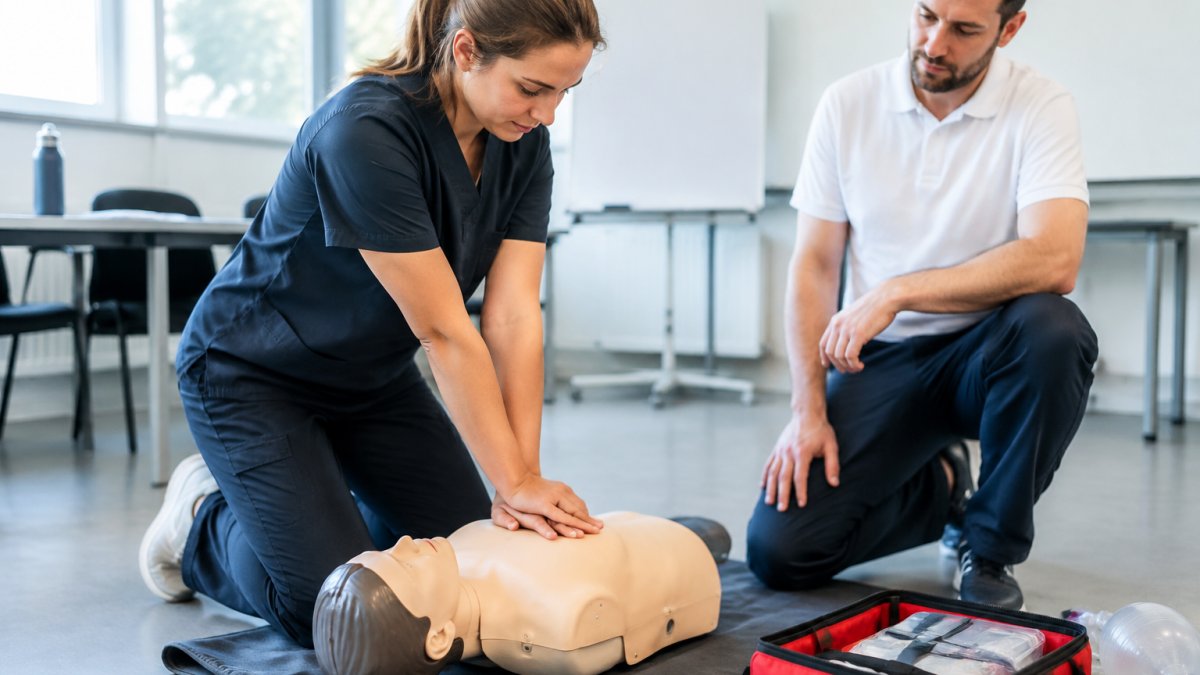
The course should be practical and hands-on. Staff need time on a manikin to build the muscle memory for compression depth and rate, and they need to practise using the AED they will actually find on their premises.
Watch out: booking a course that certifies staff without any practical assessment.
You can review the specific Basic Life Support with AED course we deliver for clinical teams.
Immediate Life Support training for healthcare professionals sits one level above BLS. It prepares staff to recognise a deteriorating patient, manage an airway with basic adjuncts, administer oxygen, and work as a coordinated team during a resuscitation attempt until advanced help arrives.
This level suits clinicians and senior nurses who may be first on scene and need to lead rather than assist.
The content should be scenario-driven, not lecture-driven. Scenario-based practice of assigning roles, running a rhythm check and handing over to a paramedic in a simulated room is a useful way to build team competence. You can find details of our Immediate Life Support course.
Onsite CPR training for clinic staff can be delivered in three broad ways, and the right choice depends on how many staff you have, how many sites you operate and how disruptive release from clinical duties is.
|
Model |
Best for |
Trade-off |
|---|---|---|
|
Onsite at your premises |
Single sites, teams of any size |
Requires a room and a half-day release |
|
Offsite at a training venue |
Small teams, occasional updates |
Travel time, staff away from patients |
|
Blended online plus practical |
Dispersed or shift-based teams |
Practical session still needs scheduling |
Onsite delivery can remove travel and let trainers use your own equipment and rooms. Group size affects scheduling, and you should check with a provider how they handle smaller teams.
If you operate across several locations, ask a provider to run the same course at each site on consecutive days. It is far less disruptive than bussing everyone to one venue.
Emergency training scenarios for healthcare staff turn abstract protocol into practised behaviour. A scenario is a short, facilitated simulation: staff respond to a realistic emergency, then review what happened. The value lies less in the simulation itself and more in the structured review that follows.
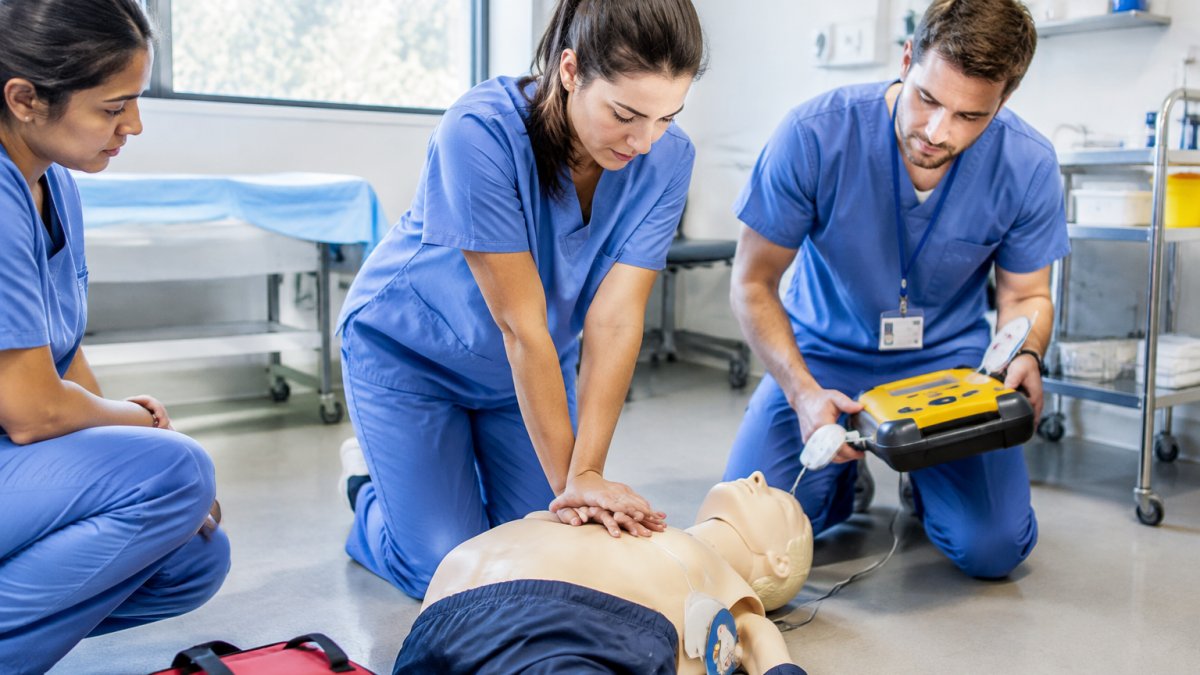
Build a library of six to ten scenarios drawn from the emergencies your clinic could plausibly face. For a dental practice, that means syncope in the chair, anaphylaxis after a local anaesthetic, and a collapsed patient in the waiting room. For a GP surgery, add a deteriorating patient with breathing difficulty and a paediatric emergency.
Each scenario needs four elements: a setting, a patient description, a defined first action, and a debrief prompt. Rotate them so the same scenario does not run every year, and record who has completed which. This gives you a defensible record of ongoing clinical competency rather than a single certificate gathering dust.
Airway management, bleeding control and paediatric resuscitation are the three competencies most often under-trained in clinic settings, and the three where delay costs the most. Course outlines often list them as topics; what clinics need is a clear picture of what competence looks like in each, what equipment it depends on, and how often it must be rehearsed.
Basic airway management in a clinic means opening and maintaining an airway with simple adjuncts while awaiting advanced help.
Suction is the piece most often missing from clinic drills. A patient who vomits during a resuscitation attempt cannot be ventilated effectively without it, and staff who have never assembled and used the suction unit under time pressure will hesitate. Rehearse it.
Watch out: assuming a bag-valve mask in the cupboard is the right size for every patient. Adult, paediatric and infant masks are not interchangeable, and a mask that seals poorly on a child wastes the ventilations that matter most. (Source: Health and Safety Executive guidance on first aid)
Catastrophic bleeding in a clinic is more often a post-procedure complication or a trauma presentation than a battlefield injury, but the principles are the same. Direct pressure with a dressing remains the first action, applied firmly and without repeated lifting to check. Where pressure alone is insufficient, wound packing with haemostatic gauze and, in extremity bleeding, a tourniquet applied high and tight are the techniques that buy time.
You can find details of our emergency trauma and catastrophic bleeds course, which covers practical bleeding control techniques.
Paediatric resuscitation deserves particular attention because children are not small adults.
Clinics that see children should rehearse paediatric scenarios at least as often as adult ones, and should hold paediatric-sized masks, airway adjuncts and defibrillator pads (with a paediatric attenuator where the device requires one) alongside the adult kit.
A useful discipline is to run one adult and one paediatric scenario in the same session, so the team practises switching between the two sets of equipment and ratios rather than defaulting to adult habits under stress.
Continuing Professional Development requirements mean resuscitation skills are not a one-off qualification. Regulatory bodies expect clinicians to evidence ongoing learning, and most resuscitation guidance points to annual updates for practical skills. The precise requirement depends on your professional regulator and your role, so check the current guidance from your own body rather than relying on a generic figure.
What competitors rarely spell out is how a clinic turns that expectation into a workable annual cycle. The practical answer is a training calendar built around your clinical governance year, not around certificate expiry dates.
A common pattern that satisfies most regulators and keeps skills genuinely current looks like this:
Record who has completed what and when. A simple training matrix, one row per staff member and one column per competency, gives you a defensible record of ongoing clinical competency rather than a single certificate gathering dust.
Regulators generally want to see more than a certificate. Useful evidence includes the date and provider of the course, the level covered (BLS, ILS or equivalent), whether practical assessment took place, and any scenario or simulation work completed in between.
Watch out: treating CPD as paperwork to be gathered at renewal. A certificate dated eleven months ago tells you very little about what a team can actually do today, and a regulator or insurer reviewing an incident will look for evidence of ongoing rehearsal, not just a qualification from last year.
Skills decay quickly without rehearsal. Short, frequent practice beats a single long session: ten minutes of compression practice once a month maintains technique better than an annual course alone. Some clinics build this into team meetings, running a five-minute scenario or an equipment familiarisation drill at the start of a monthly staff meeting. It costs almost nothing and keeps the plan, the kit and the roles fresh in everyone’s mind.
An emergency preparedness plan is the written document that tells every member of staff what to do, where to go and who does what when an emergency occurs. It is the operational layer that sits beneath individual training, and it is the piece most clinics never write.
The plan should name the emergency team roles, the location of equipment, the process for summoning an ambulance, and the route for moving a patient out of a treatment room. Review it annually and after any incident.
Pair the plan with an equipment audit checklist:
Run the audit monthly and record the result. An out-of-date pad discovered during an emergency is a failure of governance, not bad luck.
Post-incident debriefing is a structured conversation held soon after an emergency, covering what happened, what worked and what needs to change.
Hold a hot debrief within the same shift, focused on facts and immediate learning, then a fuller review within a week. Keep it non-punitive or staff will not speak honestly.
Watch out: skipping the debrief because the outcome was positive. A good result does not mean the process was sound, and unexamined near-misses tend to repeat.
Mental health support matters here too. Mental health first aid training is one option for staff who may support colleagues after a traumatic incident; details are available on our Mental Health First Aid course page.
In-house versus external training comes down to a trade between disruption and control. External courses are straightforward to book but pull staff off site, cost travel time and often train on unfamiliar equipment.
The clinical governance argument usually decides it. A provider who delivers at your premises can observe your team working in their real environment and flag gaps in your plan, your equipment or your role allocation.
Pricing depends on group size, dates and delivery location, so ask for a quote. To discuss in-house delivery and pricing, contact us.
Clinical staff in patient-facing roles need at least Basic Life Support training, refreshed annually, covering CPR, safe use of an automated external defibrillator, choking response and recovery positioning. Nurses and clinicians who may need to manage a deteriorating patient before an ambulance arrives should hold Immediate Life Support training, which adds airway adjuncts, oxygen delivery and cardiac arrest team roles. Non-clinical staff such as receptionists benefit from basic first aid and an understanding of how to call for help and direct a paramedic crew to the right room.
Basic Life Support covers the fundamentals: recognising cardiac arrest, calling for help, chest compressions, rescue breaths and defibrillation with an AED. Immediate Life Support builds on that foundation and is aimed at healthcare professionals who may need to sustain a patient until a crash team or ambulance crew arrives. It includes airway management with simple adjuncts, suction, oxygen therapy, rhythm recognition and the team roles used during resuscitation. In practice, BLS is the minimum for all patient-facing staff, while ILS suits the clinical lead or duty nurse on shift.
Yes, and for most clinics onsite delivery is the practical option. Bringing trainers to your premises means staff train in the rooms where a real emergency would happen, using your own equipment and defibrillator, and there is no need to close the practice or send people off-site during patient hours. Sessions can be split across a morning or run in short blocks to fit around appointments.
Annual refresher training is the working standard for BLS and ILS in clinical settings, with short practice sessions in between to stop skills fading. Resuscitation skills decay within months if they are not used, so many practices run a brief monthly or quarterly skills drill covering compressions and AED use alongside the formal annual course. Check your own professional body and clinical governance requirements for the exact interval that applies to your registration, and record every session so you can evidence it at inspection.
Course length varies by level and by provider, so confirm the duration of the specific course before booking. Scenario drills and equipment checks are much shorter and work best when scheduled regularly rather than as a single annual event.
Ask three things. First, whether the trainers still work in emergency or urgent care, because clinical credibility matters more than slides. Second, whether the course content is reviewed against current resuscitation guidelines and can be delivered at your premises. Third, what evidence you receive afterwards, since certificates, attendance records and a written skills summary are what you will need for clinical governance and inspection. Ask how often content is updated and request a sample certificate before booking.
Every clinic carries the same duty: to be genuinely ready, not merely certified. If your last training session is more than a year old, or your emergency plan has never been written, that gap is worth closing before it is tested. Get started with TU Training and give your team the practical competence, current equipment and clear plan that a real emergency demands.


Thanks for sharing this piece. You made the subject approachable without losing the details that make it interesting.